
Members Don't Plan Skips Ahead. That's Exactly Why You Have To.

Every season has the week where the abundance peaks and your members scatter.
Then it lands. The email from the one member you can always count on:
"Sorry, I know it's past cutoff, but can I skip tomorrow? I'm still out of town!"
That's the one you notice, because it breaks a rule and lands in your inbox. But it's the exception. Underneath it, a much bigger number is moving quietly.
Across Farmhand, 97% of order skips come in just in time, before the order cutoff. Only 3% are holds anyone set up in advance. That means members aren't mapping out their season in June. They're deciding week by week, as life comes at them.
Because a skip is almost never a decision about your farm. It's a work trip that got scheduled. A car that wouldn't start. A kid's thing nobody wrote on the calendar. Or it's the honest one — they've still got last week's cabbage in the crisper and can't face another.
Which means you're going to say yes. Whatever your written policy says, when that email comes in, you'll find a way. Every farm does. So the question was never whether to accommodate. It's whether you're doing it at 9pm on a Tuesday, one exception at a time — or whether you built a system to manage it purposefully.
Unlimited flexibility. No skips, exceptions only. Double-ups only. Skips and double-ups. Any of them work. What doesn't work is leaving it undecided and handling every request by hand.
Here's what choosing looks like on three farms.
Offer the food back, not the money.
Farmer Laci at Tagge's Famous Fruit & Veggie Farms (Perry, UT) came at this from the books. Credits and refunds eat into her bottom line, and she'd rather members get the full value of what they signed up for than a balance sitting in an account.
So when her members skip, they double up in the same step. The missed box moves onto a later delivery, the confirmation names the date it'll land, and the doubled order carries through packing and print sheets on fulfillment day. It used to take a request to the farmer — now members just do it themselves.

Let them choose the week.
Farmer Nancy at Stillman's Farm (New Braintree, MA) knows a double-up only helps if the extra box lands on a week the member can actually use it.
So she'd been letting members choose that week all along — tracking every double-up and date by hand, in columns. Fulfillment reports wouldn't match. Order reminders didn't sync. And members forgot which week they'd picked, then never came for the box at all.
Now they pick it themselves, and the calendar only offers dates Nancy actually delivers to them — so nobody lands an extra box on a blackout week or a day the farm isn't running. It flows into her fulfillment reports and reminders on its own.
Most still take it the next week. But some save theirs for when the tomatoes come in, which turns a skip into something to look forward to. 🍅

Decide your post-cutoff policies before the email arrives.
Every policy has exceptions. This one gets tested more than most — after hours, past cutoff, the morning of delivery.
Farmer Katie at Armagh Creamery (Dublin, TX) kept fielding those and needed a clean way to say yes or no.
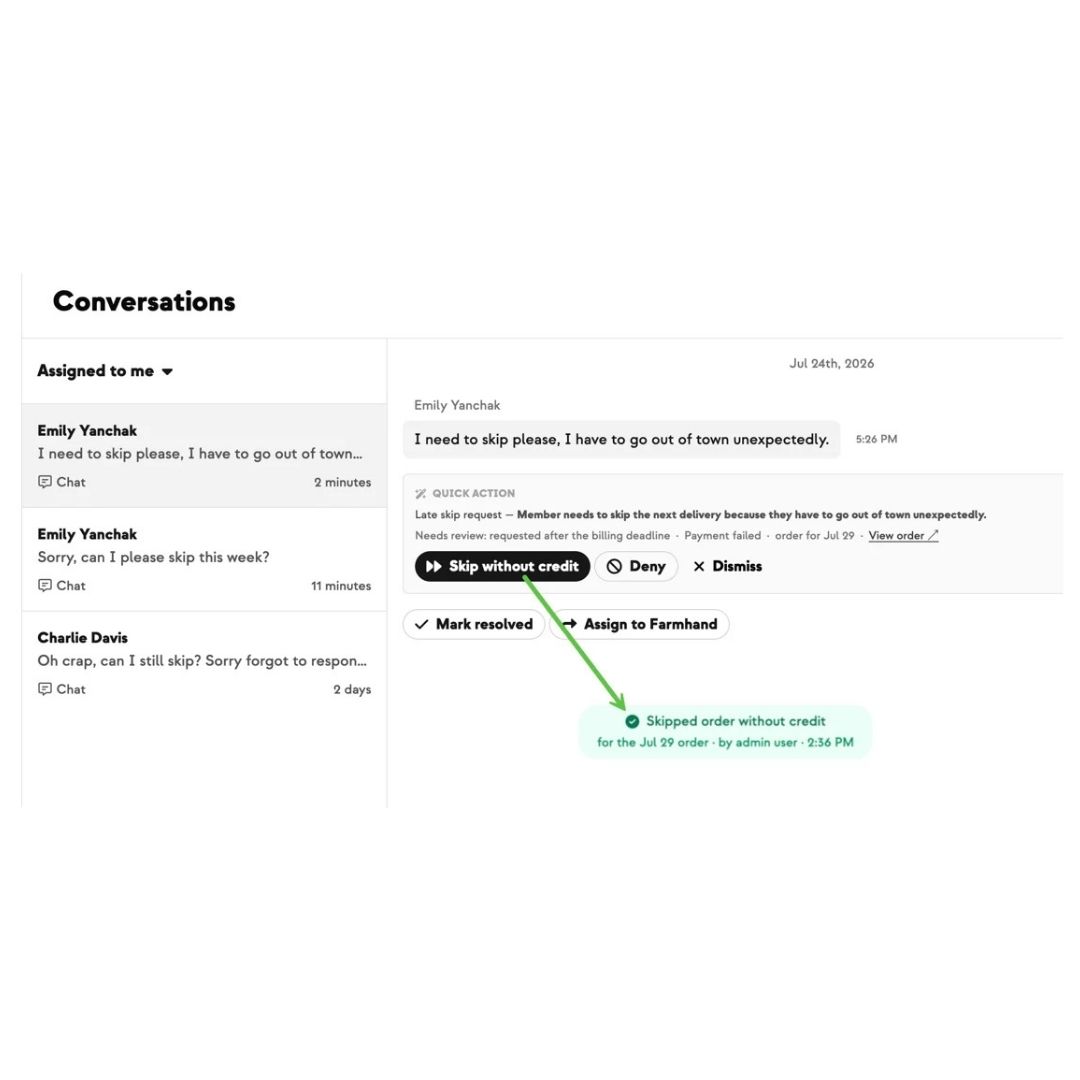
So she set two cutoffs instead of one: the order cutoff, then a final billing cutoff. In the window between them, straightforward requests resolve themselves. If the billing deadline hasn't passed and her policy allows it, the member hears back right away — credit if they'd already paid, skip/no invoice at all if they hadn't. Either way they're never billed.
Everything past the billing cutoff still routes to Katie, with three choices in front of her: skip and credit, skip without credit, or deny. She makes the call, and she's the one her member hears from. Her team can handle it straight from the order page too.
Don't let a skip be a subtraction.
One more number: the average farm on Farmhand keeps about 70% of its members year over year. The farms at the top of that range don't share a skip policy. They have nothing in common there at all.
What they share is that the product is good, the fulfillment is clean, and the member feels like they know the farmer. A skip policy can't buy retention alone. It can however ease operations in the peak of summer and create a smooth and easy member experience.
Which is why tightening the rules backfires. Make skipping harder and you don't get fewer skips — you get cancellations.
So the real work runs the other way: make the week too good to miss. Tell them what's coming before it comes. Put the thing they've been waiting all season for in next week's share. Give them a reason to stick around for pickup.
Then make the skip itself easy and boring. Pick your model — unlimited, exceptions only, double-ups only, or both — write it down, and build the system around it so it runs without you. Offer the double-up before the credit. If it won't keep, offer the friend who'll come get it. And decide the hard calls now: how late is too late, and which ones you want to make yourself.
💌 Want tips and insights like this every week? Get our newsletter
Related Content
Get the story in your inbox every week.
Real success stories from working CSA and dairy farms–delivered every week (free).
Read by 5,000+ farmers every Friday